About the cover photo: It took me three attempts of between 4 and 5 days each to get into the spot where this photo was taken. On the first two trips I suffered some very painful injuries. This spot is in the Baker River drainage in North Cascades National Park. Do you know the name of the mountain?

Converse hightops on my feet, I traverse the North Cascades in pursuit of my life project to walk into every high lake or pond mapped in the Skagit River watershed. The upper Skagit Valley near Marblemount, WA is my home and has been home to my family since 1888. I have come to feel that the culture of this place, like the culture of much of rural America, is misunderstood by an increasingly urban population and threatened by economic depression. I would like to share the stories of this place and the people who call it home. Through my stories and images of these mountains, my goal is to help others understand and respect both the natural resources and the people of the North Cascades.


Sunday, April 21, 2013

Moving the Cows


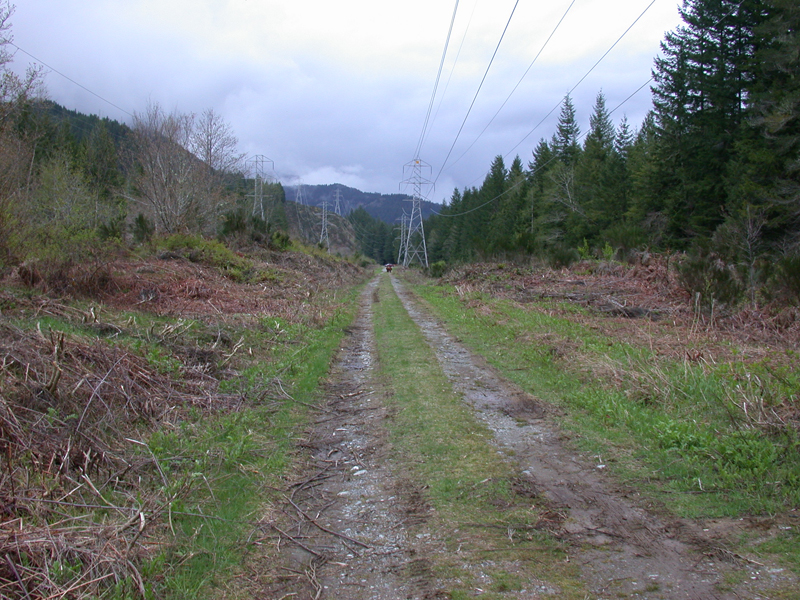
Each spring we move the cows to the summer pasture at the Stump Farm, about a quarter mile away. This involves taking them through a patch of woods and then under some powerlines to the new pasture. When I was a kid we had one or two people ahead of the cows calling them and a bunch of us kids behind herding them. In a pinch we could get by with only one or two doing the herding.

Nowadays it’s pretty much just me and mom. This is why I like to have very tame cows. When the grass really starts to green up in the spring, the older cows know it is time to move and get a little restless and hang around the back gate a lot. The trick is getting the new calves, who haven’t been to the other pasture, to come along with the rest of the herd. The older cows often get excited about going to the new pasture and run off and forget about their calves. I have had to lead cows back to retrieve their calves many times in the past. One big worry in all of this is that the calves might get lost. The calves are fairly secure when they are with the herd but would be vulnerable to predators on their own.

I deal with this problem by leading the cows with a bale of hay or bucket of grain. For a week or two before the move, I feed them toward the back gate, calling them as I take the hay out. On the day of the move, I head out like I am just going to feed them like usual only I keep going through the back gate. I try to make sure all the new calves have caught up before we head into the woods. At that point, the new calves will usually keep up.

Everything went according to plan at the start of this move. I headed to the back gate with a bucket of grain calling Com’boss, Com’boss. The new calves kept up initially but soon got sidetracked in the woods as the rest of the herd ran off. Luckily, they were familiar enough with me that they kept following me as I ran along and called. This doesn’t always happen. Sometimes they panic and run in every direction but the one you want them to.

By the time the calves and I got to the powerlines, the rest of the herd was almost to the Stump Farm. I jogged along calling Com’boss, Com’boss and the calves followed right along behind.

Several of the cows waited at the back gate to the Stump Farm. I think they had heard me calling and they started bellowing to the calves who increased their pace a bit.

The back gate is at a crossroads, so mom parked her car straddling two roads and stood guard on the other so the cows wouldn’t take off the wrong way. This isn’t usually a problem with the older cows, because they know how to find the gate and pasture. This time Gigi was standing right in the middle of the back gate. Flopsy, her calf, went through but Gigi was blocking the way for the other two calves who started down the road paralleling the fence. I didn’t think they would try to run off. They wanted to be with the rest of the cows; they just didn’t know how to get there. They began trying to get through the fence. I hopped the fence and eased them back down the fence line and toward the back gate. Mom was guarding the other road and the calves went right in the back gate. If the cows had been wilder, I would probably still be chasing some of them. 


The beginning of the move.

In the woods, the trail is narrow and space is tight. I have to be very careful not to get trampled.


The older cows have figured out that we're moving and are lining out for the Stump Farm.


When I got out under the powerlines, the main herd with all the older cows was almost at the Stump Farm. The herd is the small dot near the transmission tower. Trouble was.......

The new calves were still behind me.

The older cows have figured out that the calves aren't with them and are waiting and bellowing at the back gate.

The calves hear the bellowing.

Ma!!!

She looks like a mother doesn't she? You get over here right this instant!

New calves missed the gate.

Found the gate.

Grapeleaf has her calf but has now decided to do some exploring. I lured her back in with the grain bucket. 

Everybody is in the new pasture and heading for the lower field. 

Fresh grass for everyone. 

The End for now.

Thursday, April 18, 2013

Meet the Cows


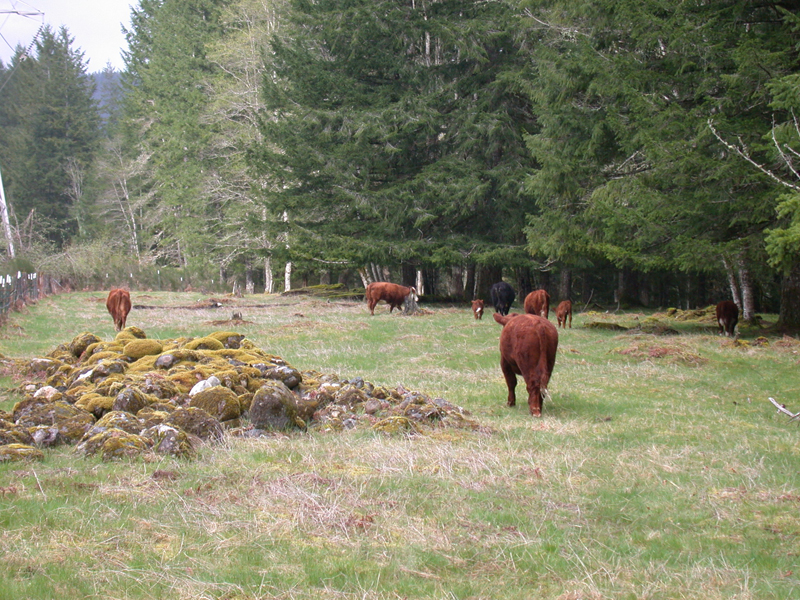
Everybody at the home pasture.

This is Dreadlocks or "Miss D" so named because she had a penchant for finding burdocks and making a matted mess of her hair when she was younger. She is descended from a cow named Clarabelle that we had when I was a kid. She is also very even tempered.
  
This is Gigi. She is an Angus/Hereford cross. I bought her a few years ago.  She is the herd or bossy cow, dominant over all the other cows.

This is Grapeleaf. So named because she used to hang around a grape vine we have near the pasture and mooch grape leaves. Her roots also go way back in the herd. She is kind of wild and obnoxious and dangerous in certain situations so I always try to keep an eye on her. She calves every year like clockwork though and without any problems which is why I keep her around. 


This is Tip. So named because he is all red except for the tip of his tail. He is Grapeleaf's calf from last year. 


This is Grapeleaf's calf from this year.
                                   

This is Miss D's calf from last year. Miss D calves quite a bit later than the others which is why this one is so small.

This is Harley and Racer who were introduced earlier. Racer is Gigi's first calf. Racer is kind of saucy and reminds me a lot of another cow we had named Heiferlumps. 

This is the newest addition to the herd, Gigi's calf from this year born 2 weeks ago. Though he is solid black like an Angus, the slightly drooping ears and head shape remind me of some Herefords I have seen. I named him Flopsy because of his slightly drooping ears. 


This would be Lil' Blackie, the new herd bull. He is a kind of rambunctious knothead. I would have preferred to have his brother, Mister Blackie (who looked a lot like him with a much sweeter personality) but this didn't happen.


Babysitting. I don't know if this is actually what they are doing, but quite often the new calves kind of cluster together while one of the older cows remains nearby and the rest of the herd moves off to another area.


Miss D gets a scratching between the shoulder blades.
                                       
Turkey vulture. One of the hangers on in the pasture. They really like haying season.


My first word was cow. My dad and a good friend that he grew up with owned cows together since I was small. This friend eventually gave his share of the cows to my dad and when my dad died, I kind of inherited the herd though they were all in my mom’s name.

Even though I grew up around cows my whole life, I learned a lot about them since I was the one responsible for their upkeep. I still have a lot to learn.

The misconception that cows are stupid is one I discovered early on. Cows are not stupid. However, they are cows and one should expect them to think and act like cows not humans or trick horses. And they are apt to be pretty stubborn about things.

Though cows are quite rough and abrupt with each other, they also groom each other and take care of one another’s calves to some degree. They will watch out for another cow’s calf but not nurse it.

When I was a kid, there were lots of us kids to help handle the cows. Now it is pretty much me and my wife and mom. I have made most of the cows pets because they are much easier to handle this way. I don’t have to chase them as much. I get away with this because they are a fairly gentle breeds—Herefords and Angus and I try to select individuals with gentle dispositions. This is not to say that they are not dangerous. They are. Not because they are mean but because they are just a lot bigger than most humans and can easily hurt you without intending to. I understand some other breeds tend to have more aggressive or mean dispositions as a general rule.

Like I mentioned before, I don’t claim to be any kind of cow expert and I know there are things I could be doing better with the herd but don’t have the time and resources at the moment. The cows are a blessing and a curse. I like pastoral settings but handling and providing for the cows can be a lot of work and a lot of responsibility. I usually end up threatening to get rid of them several times a year.


Wednesday, April 17, 2013

Pictures of the Week

Somewhere on the Upper Skagit River in North Cascades National Park. It took a day and a half of steady walking, mostly off-trail to reach the spot where this photo was taken.

Somewhere else on the Upper Skagit River in North Cascades National Park. It took about 8 hours of walking, mostly off-trail to reach the spot where this was taken.

Somewhere on the Cascade River in Glacier Peak Wilderness. It took about 8 hours or hiking about 4 hours of this off-trail to reach this spot.


Red Flowering Currant (Ribes sanguineum). A very showy early bloomer that produces berries that are edible though maybe not the best tasting.


Calypso or Fairy Slipper (Calypso bulbosa). Very pretty but also very small orchid native to the Pacific Northwest. When new, the flowers also have a very nice fragrance. These plants have very delicate roots and may also depend on fungi in the soil to provide them with many essential nutrients. Picking may actually break the roots or fungal connections of this plant resulting in its death. However, I have also observed these little beauties in woodlands grazed by cattle and in frequently disturbed stream banks so they can apparently tolerate some disturbance, at least in certain situations. 

Monday, April 15, 2013

Morel Hunt

Early or Cottonwood Morel Verpa bohemica.
       

Sometimes they hide under last year's leaves.

Sometimes they hide in the open.

Another one hiding in the open.


Some results of the expedition.


Deer seen while mushroom hunting. The deer only slightly visible a little left of center frame may have DHLS (Deer Hair Loss Syndrome).  

        
Better view of deer with possible DHLS.


 I went morel hunting a couple of days ago. Morels begin showing up in the early spring, just when the woods are beginning to green up. I’ve been working a lot of overtime the last week or so and time was pretty tight but I managed to squeeze in my one hunt for the year. I used to do this more often. The weather has warmed up a bit and we finally got some rain. Showers and sunbreaks seem to be the best weather to get the morels emerging.

I managed to squeeze about an hour into my busy day on my way home. The morels I am talking about are not true morels. These are early morels or cottonwood morels (Verpa bohemica) and they pretty much only grow beneath cottonwood trees.  

My dad taught me how to hunt these mushrooms. I understand his dad would eat them by the skilletfull. I also know people that have gotten sick from eating just a few. So one should take care not to overdo with these mushrooms especially if you have never eaten them before. Evidently even large quantities didn’t faze my grandpa.  Myself, I don’t have any problems because I don’t like mushrooms so I don’t eat them. Typically, I give them to someone who does like them. I only picked a few this year and gave them to my wife who had never tried them before. It turns out that she doesn’t like them either but they didn’t make her sick.

Morel hunting is a lot like Easter egg hunting except the mushrooms are light brown and well camouflaged in last year’s leaves unless they are on a large exposed white stalk. I know I left some behind because my eye is not really that good. It would probably be better if I looked for morels more often. My Uncle Ez, on the other hand, was very good at morel hunting. He was so color blind that he had to look at which light was lit in a stop light in order to tell whether he could stop or go because he couldn’t tell the colors apart. When it came to morel hunting this was a huge advantage because he was looking only for the shapes of the mushrooms and wasn’t distracted by color. I remember going to a favorite patch with my dad and my dad looking at some tire tracks in the mud and turning around in disgust pointing at the tracks and saying “That was Ez. We might as well go somewhere else ‘cause we aren’t going to find any here”.  

Mushrooms are the fruiting bodies of a much larger fungal organism in the soil. I am a aware of several studies that indicate that picking mushrooms doesn’t have a negative effect on future crops. This makes sense because, as fruiting bodies, the job of mushrooms is to spread spores - kind of like apples or berries are designed to spread seed. This process can be helped if something picks them and moves them around. A friend of mine who lived back east said where he lived, you were required to use mesh bags such as onion bags when you picked mushrooms so you would spread the spores around. With early morels you can pick a patch and go back after a few days or after a rainfall and find new ones along with old ones that you missed on the previous trip.

One way to ruin a cottonwood morel patch is to use a rake. One of our favorite patches was ruined for several years by someone who went through it with a garden rake. Evidently this disturbs the mycelium or “main body” of the mushroom in the soil. These mushrooms don’t seem to like areas that flood frequently either. My dad told me this years ago and I have found it to be true. I know of one very interesting spot where a clump of cottonwoods is half in and half out of the regular flood zone. You can find morels on the high ground in this clump but not where it floods regularly.

To some degree however these mushrooms have to be able to deal with disturbance, because disturbance is a constant thing in Northwest forests due to fires, floods, landslides and human-caused disturbances. The patch where I went this year was select logged in 1984 and I have been finding cottonwood morels here for at least 10 years. Actually there is a good chance this patch would never have existed if this spot hadn’t been logged. There are no old cottonwood stumps so the young cottonwoods here seeded into the opening created in the forest when it was logged.

I move slowly and deliberately scanning the ground while hunting cottonwood morels and don’t make a lot of noise. Just as I was getting ready to call it quits I saw several deer. The first one almost walked on top of me. I heard a twig snap and then another then I saw something out of the corner of my eye only a few yards away and just about jumped out of my skin before realizing that it was a deer.

One was shedding heavily and may have had DHLS (Deer Hair Loss Syndrome). It looked rather strange with a large patch of hair gone on its side and the hair underneath a strange yellow/orange color. I understand that this condition, while it doesn’t do the deer any good, isn’t necessarily fatal. I watched the deer for several minutes and snapped a few pictures while they browsed new growth on some salmonberry bushes.  

Sunday, April 14, 2013

Sunday 4.14.13

Today Sunday: Alarm at 6:00 a.m. Slept in until 6:45. I hung out with my wife and daughter for a bit then headed up the road to mom's and the farm arriving at about 8:00 a.m.

Walked the dog as per the usual routine. Then tried cutting a round out of a big maple tree we had taken down several weeks ago. The round was about 3 feet in diameter and out of the top of the tree. There were some old tops cut out years and ago and I wanted to see how much rot was in the top. I ruined my saw chain on a piece of hardware a nail, spike, screw, bolt, wire etc.

A friend of mine who was interested in the log for the spalted and/or figured wood stopped by. I finished cutting the round out of top with new chain and without damaging the chain. The round out of the top looked pretty good. After a good bit of thinking my friend decided it would be worth a gamble of time to cut up the log and see what it looked like. We made plans to do this next weekend.

I spent most of the rest of the day trying to get the tractor running with the help of another friend. The tractor is having problems with the fuel supply. I tore the fuel lines apart several times and drained and refilled the gas tank several times to no avail.

My wife and daughter came up and we walked the dog again.

After they left I turned back to the tractor and tore into the sediment bowl and fuel tank. After checking cleaning and reassembling everything, I tried again. Same problem. Time to stop and reconsider and ask for more help.

I fed the cows, then whittled on the big maple for about an hour more, cutting out two more big rounds and several limbs and knots.

I went home, ate dinner and mowed the lawn until dark (got it done). Sacha offered to help with the lawn but didn't have ear plugs and I didn't want her to have to use my used ones so I finished the lawn.

I took a shower and am now writing this.

I am pretty tired. More later.

Thursday, April 11, 2013

Community Hall Meeting


I attended the meeting for the Marblemount Community Hall last night. The good news is that the hall won’t be foreclosed on. The bad news is that the debt that resulted in the possible foreclosure won’t be forgiven. However, this isn’t all bad news because we will have a little leeway to get the debt paid off.

Some of the following talk involved ideas for fundraisers to raise money not only to pay off the debt but also to keep operating. This can be really tricky because one of the better fundraising activities involves cooking and selling food and runs the risk of cutting into the margins of businesses in town that probably don’t have very big margins to start with. We want to maintain good relationships with the businesses in town and you can't do that by putting them out of business.

The Community Hall is a place available for people to gather for meetings or hold events (Sacha and I were married there). It is where the Red Cross would set up in case of disaster and the volunteer fire department building is on its land. It seems that people use it pretty regularly. 

The hall is basically run as a community service and doesn’t make a profit. In fact it is a struggle every year to come up with enough money to keep the hall open. In fact, if it were not for the herculean efforts of just a few people it would have closed by now. Over the years I have seen these few people give freely and generously of their time and resources to keep things going for no pay, no compensation and rarely even a thanks. Personally, I could have helped more but didn't.  

Due to the way the Community Hall was originally created, it doesn’t qualify for 501 3C non profit status. It was originally called the Marblemount Community Club and club memebers paid dues and contributed to its upkeep. It was a civic club not an exclusive club and it provided many important community services for free or at low cost. If the Community Hall was a 501 3C, the debt would probably have been forgiven without much trouble and more people and businesses would be willing to donate because they could write it off as a tax break. This was talked about as well.

Incorporating as a 501 3C is a little complicated. There are a lot of hoops to jump through and it will take time to get things written up properly. We haven’t even identified someone who might help with this or how much that will cost. This is a slow process as we are a small group with busy lives and not a lot of outside resources or networks and not a lot of money in the local community.

It seems like there were more resources back in the era when the Community Hall was started, more money and more people available to help. I have the impression that there were more businesses with more wealth that were based here and were willing to donate and help out with an eye on civic responsibility rather than the bottom line. I wouldn’t doubt that many of the viable businesses here now are getting a little tired of being solicited for donations on a regular basis because there a fewer of them around to spread out the pressure for such things.

All of the stuff about acquiring funds and paying the bills is hard to figure out at the end of the day when you are tired from work. It seems that we, like some other groups in eastern Skagit County are kind of stumbling from crisis to crisis trying to keep our heads above water. I don’t think things are impossible now, just hard and slow. And it seems like more people may be interested in getting involved with the hall. I only hope the people we will be soliciting for funds don’t get burnt out on the steady stream of fundraisers. 

Wednesday, April 10, 2013

Spring 2013


Photo of the week. Somewhere in the Upper Skagit River in North Cascades National Park. Do you know where this is?

Same place as above in the early evening. It took one and a half days to get here, during which I fell about 20 feet and suffered a concussion (I assume because there was no doctor there to diagnose me). 

Skunk cabbage, Lysichiton americanum. One of the first flowers of spring, brightening wetlands.

Oval-leaved blueberry, Vaccinium ovalifolium. This is the bush near the trail where I walk the dog.

Oval-leaved blueberry, Vaccinium ovalifolium. This is the more common flower coloration that I have observed.

Salmonberry, Rubus spectabilis.

Osoberry or Indian plum, Oemleria cerasiformis.

Trillium, Trillium ovatum. New bloom.

Trillium, Trillium ovatum. Old bloom. The petals of this species turn pink to purple after pollination and soon before falling off. There are some Trillium species whose flowers are deep red to purple at first bloom. 

I had been going to write about this earlier but a number of projects postponed it and, as usual, spring happened before I knew it.

I’m sure everyone has their own personal measure of when spring has arrived. For me the seasons were never really linked to any calendar date. Before I was aware spring officially arrived around the 21st of March I always considered spring to be when everything started greening up and the air started smelling like growing plants. This is usually a several weeks after the 21st of March and even later in cold years here. Like many, I am sure, I keep an eager eye out for the first signs of spring.

There are some blue violets that seem to be associated with old homesteads that may bloom as early as February, about the same time as snowdrops and the catkins of the hazelnut trees around the house are open by the middle of February most years. None of these plants are native, that is, they did not occur here before European contact so they might not necessarily be in synch with plants that have existed here for thousands of years.

Willows bloom late in February most years and are done flowering well before they leaf out. Pussy willows (catkins) are one of my earliest harbingers of spring along with skunk cabbage which brightens wetlands first thing in the year.

Another of the first native plants that I see blooming is an oval-leaved blueberry Vaccinium ovalifolium that blooms by the trail where I walk the dog. The leaves of this species pop out at the same time as the urn shaped flowers. Most of the oval-leaved blueberry that I see have showy pink blossoms. This particular bush has white flowers with darker pink centers and I love it because it seems a little more elegant. This species blooms at the end of February or early March or even later, depending on elevation. Green berries are already beginning to swell on the bush by the trail.

Other early blooming native plants are osoberries and salmonberries. Nettles may begin growing early in March but won’t bloom until much later. These seem to be “hotter” or to sting more painfully when they are just getting started on their growth for the year.

One major sign of spring that goes back to my childhood is the blooming of Trilliums (Trillium ovatum). Our common name for these was “wild Easter lily” because they usually begin blooming around Easter on most years. Though they are not true Easter lilies, they are in the lily family.

Bird activity has ramped up. I’ve been hearing woodpeckers hammering on sounding boards or stovepipes or mailboxes and I’ve been hearing varied thrushes for two or three weeks now. Two Canada geese showed up in our pasture last week. I think these may be the same ones that have been hanging out in our pastures for the last several years in the spring. I haven’t heard ruffed grouse drumming yet though.

Red-legged frogs breed in ponds as early as late February or early March. This year I saw dozens of them crossing the road on warmer nights in early March in order to get to breeding ponds. The Pacific tree frogs are very vocal right now. Only the males of this small species sing. On the warmer, often rainy nights, their chirping chorus creates a pleasant racket in the spring air.