About the cover photo: It took me three attempts of between 4 and 5 days each to get into the spot where this photo was taken. On the first two trips I suffered some very painful injuries. This spot is in the Baker River drainage in North Cascades National Park. Do you know the name of the mountain?

Converse hightops on my feet, I traverse the North Cascades in pursuit of my life project to walk into every high lake or pond mapped in the Skagit River watershed. The upper Skagit Valley near Marblemount, WA is my home and has been home to my family since 1888. I have come to feel that the culture of this place, like the culture of much of rural America, is misunderstood by an increasingly urban population and threatened by economic depression. I would like to share the stories of this place and the people who call it home. Through my stories and images of these mountains, my goal is to help others understand and respect both the natural resources and the people of the North Cascades.


Monday, May 13, 2013

Mother's Day Weekend, a new cow and the big maple-again.


I had planned to go to the auction in Everson on Saturday to try to get a feeder cow to butcher this fall. We lost two calves last spring and will be short two come butchering time. I don’t usually like getting replacement cattle because it increases the chance of introducing disease into the herd and the new animal is always a bit of a wild card as far as behavior goes. But I wanted to get at least one replacement so we wouldn’t have to turn down any of our regular beef customers.

When I have to buy replacement cattle, I usually hope to, at best, break even. I once paid $900 dollars for a big steer and had it drop dead on me several months before butchering time. So I paid $900 with the end result of having over one thousand pounds of smelly dead beef carcass to deal with. The bears, coyotes and turkey vultures loved it though and had it cleaned up within a month.

This time around I was ready to go to Everson but tried an ad in the Little Nickel first and it sounded like as good a deal as I was likely to get at the auction. The guy I called had to work Saturday so we agreed to meet on Sunday.

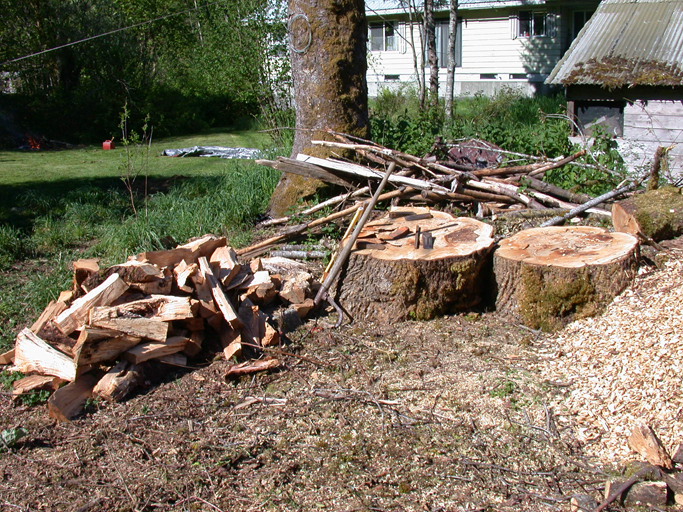
I spent the rest of Saturday morning rounding up cash and doing a little last minute Mother’s Day shopping. The afternoon I spent working on the big maple. I was able to get most of the remaining tougher blocks split and got all of the largest logs cut into blocks before quitting for the day. The temperature in the morning had been pleasant but by 1:00 in the afternoon when I got started, it was in the mid-80’s and very muggy due to humidity spreading ahead of the rain that was coming that evening. It didn’t take much to work up a sweat and keep it up.

Sunday morning I was up at about 6:00 a.m. I was supposed to be in Marysville to look at the cows at 10:00 in the morning and we were supposed to have dinner with my mom and Sacha’s mom at our house at 5:00 p.m. I got up to the farm at about 6:30 and hitched the stock trailer to the farm pickup and made some final adjustments before walking the dog and picking some lilacs, flowering dogwood and serviceberry for a bouquet for Sacha.

I was on the road at about 8:00 a.m. I stopped and presented some European chocolates and the bouquet to Sacha (Vashti liked the bouquet too) and was on my way. The trip to Marysville was pretty uneventful. I took the back way so didn’t have to do too much freeway time with the old pickup and trailer.

There were several cows to choose from and I chose a yearling freemartin heifer. Freemartins are females with male twins and are usually sterile. Freemartin was a new term for me though, according to Webster, it has been in use since 1681. I had been aware of other problems associated with twin cattle. The trip home was uneventful as well and when I released the new cow in the pasture, it looked like things would go well. It is always interesting when you release a new adult cow into an established herd. Sometimes there are challenges and a lot of head butting, sometimes not, but usually there are a few laps around the pasture by the entire herd and the new cow.

Sacha was at the farm, working on her grapes. I helped her a little bit in getting the weedeater going and doing some minor repairs on the rototiller.  She suggested naming the new cow Mary since she came from Marysville. I am a little cautious about naming this cow since she won’t be with us that long. In addition, she isn’t supposed to be able to have a calf but what if she did? And being named Mary? I am not overly religious but I don’t even want to go there.

The trip to get the new cow had taken about 4 hours so I had a few hours left to work on the big maple. I managed to get all of the blocks that I had cut the day before split. It was a lot cooler with rain showers this day but it was still muggy and the sweat flowed freely.

Dinner was very good. Afterward both our moms jumping into cleaning the dishes. I felt like kind of a slacker. Washing the dishes is usually my job and it was Mother’s Day after all and I ended up hardly touching a dish. In addition, Sacha cooked a very delicious dinner that I had not a hand in making (other than raising the beef that was the main dish).  I know Sacha is worn to a frazzle trying to keep up with our toddler daughter. I wish I could have done a little more for her and our moms who were undoubtedly worn to a frazzle with us on Mother’s Day. There don’t seem to be enough hours in the day to get everything done that needs to be done.


Start of day Saturday.

Start of day Saturday.

End of day Saturday.

Sunday. New cow apprehensive about leaving stock trailer. 


The greeting committee arrives. 

Much bellowing from both sides ensues. 

Grapeleaf usually leads the way when a new cow arrives.

Grapeleaf is not the dominant, or herd cow but she is very pushy. She is also fairly small and often gets thumped in these situations. 


Of course Lil' Blackie needs to check out the new girl in town. 

And they're off. 

Miss D is lagging behind because she is very pregnant. 

They've made a turn and are headed back. Miss D has cut the corner and momentarily caught up. The new cow is actually near the rear of the herd at this point. 


Off into the mist they go.

The new cow after settling in.

Sacha tilling around her grape arbor. 


Start of the wood project Sunday.

Start of the wood project Sunday. 

End of the wood project Sunday.

End of the wood project Sunday.

Sacha and Vashti.

Thursday, May 9, 2013

Pictures of the Week 5.9.13

Large-leaved Avens (Guem macrophyllum). These plants in the rose family are now beginning to bloom. Evidently they are pollinated and seeds begin to develop rather quickly after blooming. The petals rarely last on the flower for more than a day or two, making it hard to get a good photo of a flower in full bloom. 

Large-leaved Avens (Guem macrophyllum). 

Somewhere in North Cascades National Park, summer 2005. It took about 8 hours walking a climber's route to reach this spot. I had a devil of a time pitching my tent because the wind was howling so strongly. 

Somewhere in North Cascades National Park, summer 2005. Most maps still show this lake covered with a permanent snowfield. 

Somewhere in North Cascades National Park, summer 2005.

???

Monday, May 6, 2013

Weekend May 4 and 5, 2013


The first item of business this weekend was to take a pile of tires Down Below to Sedro-Woolley to get rid of them. There were 45 tires in all. I don’t know if these were a natural accumulation or my dad had been saving them for some purpose. At any rate they had to go.

Marblemount is not completely isolated but it is a pretty good investment in time and gas to get Down Below (Sedro-Woolley, Burlington, Mount Vernon). So most times when we go down we have a list of things to take care of. On this trip, I got rid of the tires, got the oil changed in the farm pickup, picked up a tractor part, got a haircut, got some items that I couldn’t get at the grocery store in Concrete, picked up some new underwear, visited with an old friend for a few minutes and stopped in Concrete at Albert’s Red Apple to finish my shopping.

I still had time to go up to the farm, walk the dog with my wife and daughter and put the tractor part on the tractor. We also attended a fundraiser potluck dinner and dance for the local radio station KSVU 90.1 F.M. Unfortunately by that point, I was pretty tired so was probably not very good company for some folks. We only stayed a little more than an hour before going home to find one of the chickens had died probably due to heat stress. That was the end of the day.

I got started early Sunday, partly because I had a lot to do and partly to beat the heat. Between a small burn pile to dispose of some weedy debris and helping Sacha with her grapes, I went to work splitting the last two 3 foot diameter maple rounds.

The first maple round was easy but the second was really tough, taking me about 2 hours to split. It was after 1:00 in the afternoon when I finally finished with it and my forearms and lower back were beginning to cramp and I had a headache. The headache and cramps may have been due to dehydration though I tried to make sure I drank plenty of water. This was the first really hot day of the year and I would ordinarily save jobs like this for cooler weather. But my time is limited this year, so after finishing with the big rounds, I bulled on through, cutting and splitting some more of the maple. I called it quits for the day at about 4:30 p.m.

At 5:00 p.m, I finally remembered to look at a thermometer. Actually I looked at two, both of which were in the shade. One said 90 degrees F and the other read 84. I had survived with a few cramps and a blister on my little finger. Hopefully this will help me start to get ready mentally and physically for haying season.

I finished the day by walking the dog up to the Stump Farm and watering the cows. The creek was up a foot or a little more from snowmelt. After dinner, I helped Sacha put up some chicken wire for a fence around her garden.


Farm pickup with pile of old tires in front of old chicken coop waiting to be loaded. 

Add caption

Start of the day Sunday.

The two remaining large maple rounds each about 3 feet in diameter. The pile of wood to the left is the large round I split last weekend. 

One down. One to go. This round would take me about 2 hours to split. I ended up having to use the powersaw to cut through a lot of the large knots and cross grained wood. 

Finis, finally. Now on to some of the smaller stuff. 

Some more, smaller logs from the same tree. 

Cut into stove length rounds. 

Split and ready to be stacked in the woodshed. The smaller rounds split very easily. 

Saturday, May 4, 2013

Pictures of the week 5.4.13


Somewhere in North Cascades National Park, summer 2004. It took me about a day and a half to reach this spot about half of which was off-trail.  I took the hard way. At one point on the trip one sweat soaked hour got me less than a quarter of a mile through giant rocks overgrown with vine maple. I was also stung by yellowjackets several times, once over my left eye near the eyelid.

Somewhere in North Cascades National Park, summer 2005. It took about 9 hours of walking, mostly off-trail to reach this spot.

Serviceberry or Saskatoon. Amelanchier alnifolia. I have noticed recently that these are blooming. The berries of this bush are sweet though the seeds are a little big. These berries were an important food source for Native Americans. These bushes will survive in the forest understory but they do best and produce the most berries in open areas. 

Serviceberry close up. I have read from a somewhat dubious source how serviceberries were named. In the old days in the north where the ground was too frozen in the winter to dig graves, the bodies of people who died during the winter were saved until spring when graves could be dug. Serviceberries were one of the flowers that were available at that time for funeral services. 

Serviceberry very close up. These bushes are a member of the rose family or Rosaceae. The main distinguishing characteristic of this family is flowers with 20 or more stamens (stamens are the male part of a flower).

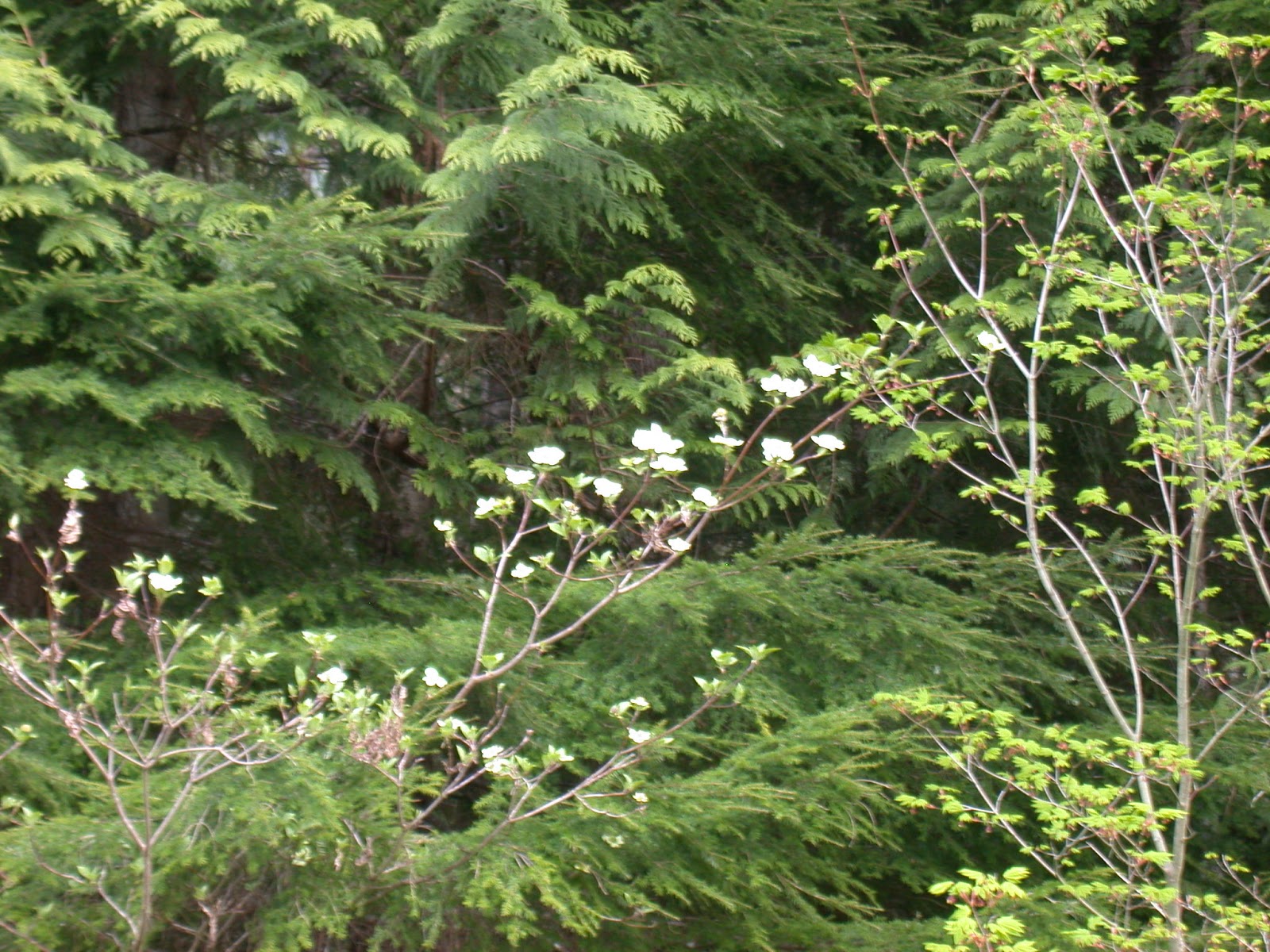
Pacific flowering dogwood (Cornus nuttallii) is another plant currently flowering.

The large white "petals" are actually bracts which are specialized leaves that are below the petals. The real petals are on the small flowers in the ball in the center. 

Close up of Pacific flowering dogwood flower showing the very small flowers.  These will mature into red fruits similar to berries with one large seed per fruit. I have seen the crops of ruffed grouse stuffed with dogwood fruits.

Highly manipulated photo. I took a dogwood flower with almost perfectly symmetrical bracts and put it in a snowbank for this effect.  

Wild strawberry (Fragaria virginiana). These are blooming now. They do best in open areas like roadsides, pastures and bluffs. I almost never see them in the woods. 
Woodland strawberry (Fragaria vesca) is often encountered in open areas at the edge of the woods.  Note the veins are deeper on the leaves of this species and the flower petals are toothed rather than smooth as in the wild strawberry. 
Close up of woodland strawberry. I have never found these strawberries to be as flavorful as the wild strawberry (Fragaria virginiana). Strawberries are also in the rose family.                                               

Slide alder, Sitka alder or "tag" alder as my dad used to call it (Alnus sinuata). These are probably best known in this area for growing in avalanche tracks but I have recently noticed them growing in areas at lower elevations. This one is on the edge of a powerline right of way at about 400 feet elevation. I have also noticed them along stream beds at these lower elevations.
                                                                  
Close up of slide alder catkins. I think my dad got the name "tag" alder for these springy shrubs because when you try to walk through a thick patch of them they are constantly springing back and "tagging" you.